PACKAGING EXPERTISE. RESPONSIVE SUPPLY.LET’S TALK PACKAGING   /   1-800-498-4215
Barrier packaging for sensitive products

Aluminum Foil Liners

Control exposure.
Protect what matters inside.

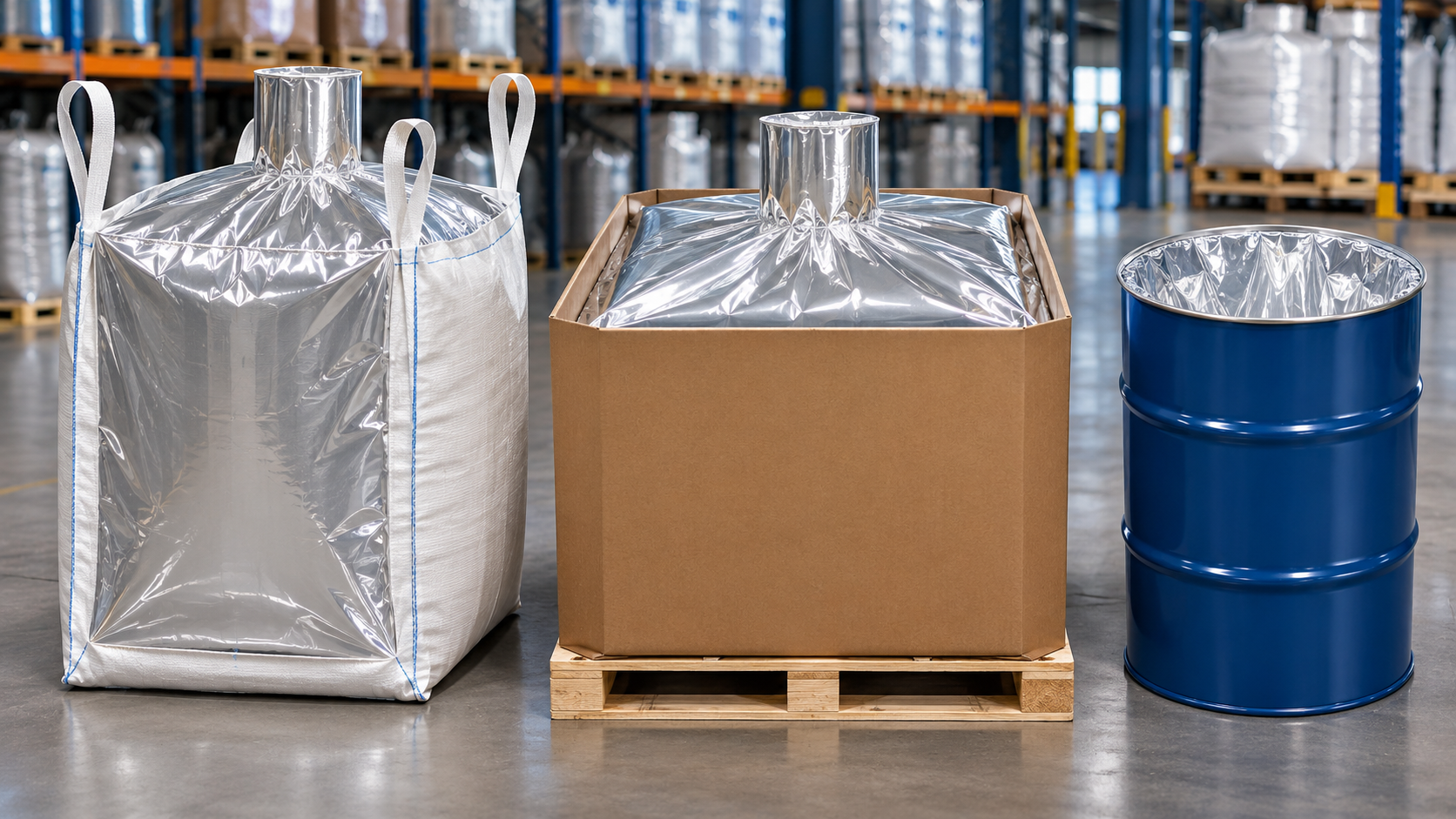
Explore foil laminate liners for FIBCs, Gaylord boxes, and steel drums. Bring moisture and oxygen barrier targets, liner fit, and vacuum-sealing requirements into one packaging review.

Aluminum foil liners inside a white FIBC bulk bag, a Gaylord box, and a blue steel drum in a warehouse
Foil liners • FIBCs • Gaylord boxes • Steel drums
Put the barrier values first

Moisture transmission.
Oxygen transmission.

Lower transmission rates indicate less permeation under the same test conditions. Specify the maximum rate your product needs and verify the proposed laminate’s report.

Moisture barrier

MVTR / WVTR

Published laminate example

0.0005 g/100 in²/24 h

Approximately 0.0078 g/m²/day · ASTM F1249

Water vapor passing through a unit area of material over time. Review temperature, humidity conditions, laminate structure, and the test method.

ASTM F1249 method overview ↗
Oxygen barrier

OVTR / OTR

Published laminate example

0.01 cm³/m²/24 h

Oxygen transmission · ASTM D3985

Oxygen passing through a unit area over time under stated conditions. Confirm temperature, humidity, oxygen pressure difference, and whether the value is pressure-normalized.

ASTM D3985 method overview ↗

Illustrative published values—not a Bulk-Pack product rating. The example above is for one published 5 mil kraft/PE/foil/LDPE laminate. Actual MVTR and OTR vary by manufacturer, laminate structure, foil thickness, processing, and test conditions. The reference sheet does not state temperature, humidity, or oxygen pressure conditions; confirm these and obtain the current report for the proposed liner. These figures are not guaranteed for every foil liner or finished package.

Compare complete specifications. Values expressed per 100 in² and per m² are not directly interchangeable. Confirm units, conditions, and detection limits. Request verified MVTR and OTR values for the proposed laminate; no universal foil-liner rating applies.

Three outer package formats

The barrier inside.
The right fit around it.

Review liner dimensions, protection, and access with the outer package and the filling and emptying process.

01 / Bulk bags

FIBC foil liners

Define body shape, filling and discharge spouts, attachment, seal access, and compatibility with the complete FIBC design.

02 / Boxes

Gaylord box foil liners

Specify box inside dimensions, liner allowance, top opening, sealing access, and the intended loading and emptying arrangement.

03 / Drums

Steel drum foil liners

Provide drum inside diameter, height, lid and closure details, liner opening, seal location, and any vacuum-processing requirements.

Coffee & similar sensitive products

Barrier performance.
A vacuum seal to match.

Foil barrier laminates and vacuum sealing are worth reviewing for coffee and other products sensitive to oxygen or moisture. Discuss beans or grounds, ingredient powders, and similar dry products around their specific protection and processing needs.

A vacuum step removes air; the laminate and finished seal help manage subsequent exposure. Review the film’s heat-seal layer, evacuation process, seal settings, residual oxygen target, and finished-package integrity together.

Freshly roasted coffee needs a gas-management review. Discuss roast-to-pack timing and carbon dioxide release before specifying a vacuum-only package. Review any degassing, valve, or gas-flush requirements with your process and product team.

The Bulk-Pack difference

Bring your barrier targets.
We’ll work through the specification.

Review the outer package, laminate, sealing process, and product requirements together.

01 / Specification

Laminate & barrier targets

Identify the laminate structure, total thickness, foil layer, sealant layer, and required maximum MVTR and OVTR/OTR. Include the relevant test reports.

02 / Specification

Outer package & liner fit

Send the FIBC drawing, Gaylord box inside dimensions, or steel drum inside diameter and height. Include openings, allowances, attachment, and closure details.

03 / Specification

Product & contact conditions

Share your product, filling temperature, food-contact requirements, sensitivity to moisture and oxygen, and intended storage period.

04 / Specification

Vacuum & sealing process

Specify the vacuum equipment, evacuation method, target vacuum or residual oxygen, seal width, and sealing conditions to be reviewed.

05 / Specification

Handling & package integrity

Describe installation, filling, palletizing, storage, and transport. Include abrasion, puncture, folding, and seal-integrity concerns in the review.

06 / Specification

Validation & supply

Define the acceptance criteria, package testing, product shelf-life evaluation, documentation, order quantities, and delivery needs.

Dimensions, barrier performance, sealing suitability, and shelf-life outcomes are application-specific. Bulk-Pack can help review the proposed liner and supporting documentation with your team.

Common questions

Clear barrier data.
A better packaging decision.

Are MVTR and WVTR the same type of measurement?

MVTR is commonly used for moisture vapor transmission rate; WVTR refers to water vapor transmission rate. Compare the actual report, units, method, temperature, and humidity rather than the abbreviation alone.

What does OVTR mean?

OVTR is the oxygen transmission label used on this page; test reports commonly use oxygen transmission rate (OTR). Request the laminate’s OTR report with units and test conditions, including oxygen pressure conditions.

What MVTR and OVTR values do these liners achieve?

The rating depends on the specified laminate and its test conditions. The displayed published example is 0.0005 g/100 in²/24 h MVTR and 0.01 cm³/m²/24 h OTR for one laminate. These are reference figures, not guaranteed ratings for the liner you order. Ask Bulk-Pack for confirmed values and test conditions for the proposed construction.

Can foil liners be vacuum sealed?

Vacuum sealing can be specified with a compatible laminate, sealant layer, and sealing system. Review the package size, product, evacuation method, seal settings, and package-integrity checks together.

Are these useful for coffee?

Coffee is a useful application to review where oxygen and moisture exposure matter. Discuss whole-bean or ground product, roast timing, gas release, filling conditions, storage duration, and the proposed vacuum or gas-management process.

Does a low film transmission rate guarantee shelf life?

No. Laminate test results describe the tested material under stated conditions. Seals, closures, handling damage, residual oxygen, product characteristics, and storage conditions also need review and finished-package evaluation.

Can a foil liner replace another liner in a certified FIBC?

Review the change against the complete bag design and any applicable food-contact, electrostatic, or hazardous-materials qualification requirements before substitution.

Let’s talk packaging

Let’s review your
foil barrier liner requirements.

Share your FIBC, Gaylord box, or steel drum dimensions; product; target MVTR and OVTR/OTR with units and test conditions; storage period; vacuum and sealing equipment; and quantity.

Start a conversation

Tell us a little about your requirements.

Share a specification sheet, drawing, or product photo.

Preview: files stay on your device. Attach them manually when your email opens.

Draft preview: this prepares an email in your email app. Online submission will be connected during implementation.

Your inquiry is ready.

This preview prepares an email for your review. Your inquiry has not been submitted through the website. If you selected specification files, attach them manually in your email app.

Open Email App ↗