
Start with the process
Moving product can create electrostatic charge. The material, equipment, and surrounding atmosphere all matter when selecting a bag.
Static dissipation.
Built into the fabric.
CROHMIQ Type D bulk bags dissipate electrostatic charge without requiring a bag-to-ground connection. Let’s match the bag design and documentation to your product and process.
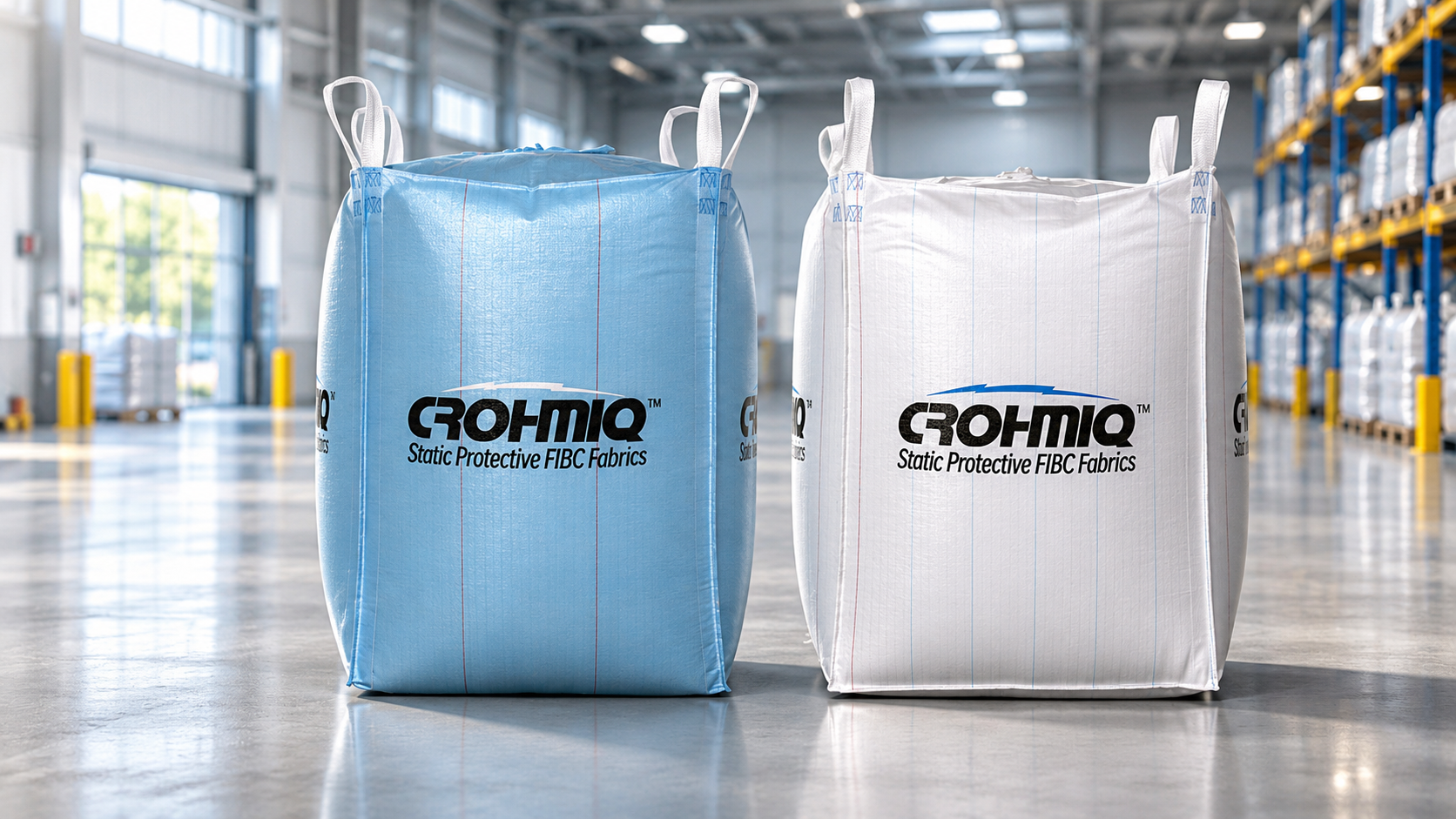
Filling and emptying can generate static charge. CROHMIQ fabric uses a different dissipation mechanism from a grounded Type C bag.
Moving product can create electrostatic charge. The material, equipment, and surrounding atmosphere all matter when selecting a bag.
CROHMIQ incorporates quasi-conductive yarns within polypropylene fabric to help control accumulated charge.
The fabric releases charge into the surrounding atmosphere through low-energy corona discharge, without a bag-to-ground connection.
Technology summary: Texene / How CROHMIQ works ↗
| Consideration | Type C | CROHMIQ Type D |
|---|---|---|
| Charge dissipation | Conduction through a connection to earth | Low-energy corona discharge through the fabric |
| Bag grounding | Required during filling and emptying | No bag-to-ground connection required |
| Selection | Review the complete application, compatible liners, tested limits, and operating instructions. | |
Send your current specification or describe the operation. We’ll help bring the requirements into one discussion.
Product characteristics, filling and emptying methods, potential atmospheres, and your site’s hazard assessment.
Dimensions, safe working load, lifting loops, openings, discharge arrangements, and printing.
Liners, attachments, and other components must be compatible with the specified static-protective design.
Design-specific test documentation, labelling, food-contact requirements, quantities, and delivery plans.
Bulk-Pack is a Texene partner and licensed CROHMIQ manufacturer in Mexico. Our company-owned manufacturing and 45+ years of FIBC experience bring practical design knowledge to your application.
Talk with us about custom runs, your current specifications, and supply planning. We can help review requirements before you commit to a construction.
Explore original CROHMIQ technical resources from Texene. Share any questions with our team as we review your requirements.
The fabric technology behind static dissipation.
Read CROHMIQ guidance ↗Technical Note 133 explains bag grounding and classification.
Read CROHMIQ guidance ↗Understand why the label and tested limits matter.
Read CROHMIQ guidance ↗Care and handling guidance from Texene.
Read CROHMIQ guidance ↗Technical Note 131 addresses fabric and component considerations.
Read CROHMIQ guidance ↗Explore the technical framework for static-protective FIBCs.
Read CROHMIQ guidance ↗CROHMIQ® and Continuous Safety Certification™ are Texene trademarks. Technical summaries are adapted from the linked CROHMIQ resources.
CROHMIQ Type D fabric dissipates charge without a bag-to-ground connection. This does not remove grounding requirements for other conductive equipment, objects, or personnel. Follow the bag instructions and your site’s operating procedures.
Texene’s Technical Note 133 explains that a CROHMIQ bag may be grounded when required by site procedures. Grounding it does not change its classification to Type C. Review the intended arrangement with us.
The liner must be compatible with the complete static-protective bag design. Send the liner material, construction, and intended use so the bag-and-liner combination can be reviewed.
Yes, we can review food-contact requirements. Suitability depends on the complete bag, including coatings, sewing materials, liners, and the intended contact conditions. Request documentation for your specific construction.
Do not assume a bag is suitable for reuse. Texene discusses reuse within a properly designed refurbishment and safety-testing program. Review the specific design and operating conditions before considering reuse.
Yes. Send your specification, product information, process details, and required documentation. We can identify points needing clarification and discuss design options.
Share your product, filling and discharge process, operating environment, bag design, and quantity. Include your current specification and any liner requirements.