
U-Panel
A continuous panel forms the bottom and two opposite sides, with separate panels completing the body. Review dimensions, seams, and lifting requirements together.
Your product. Your process.
A bag built around both.
From body construction to the last closure detail, the right FIBC starts with how your operation works. Review bag shape, filling, lifting, product protection, and discharge in one complete specification.
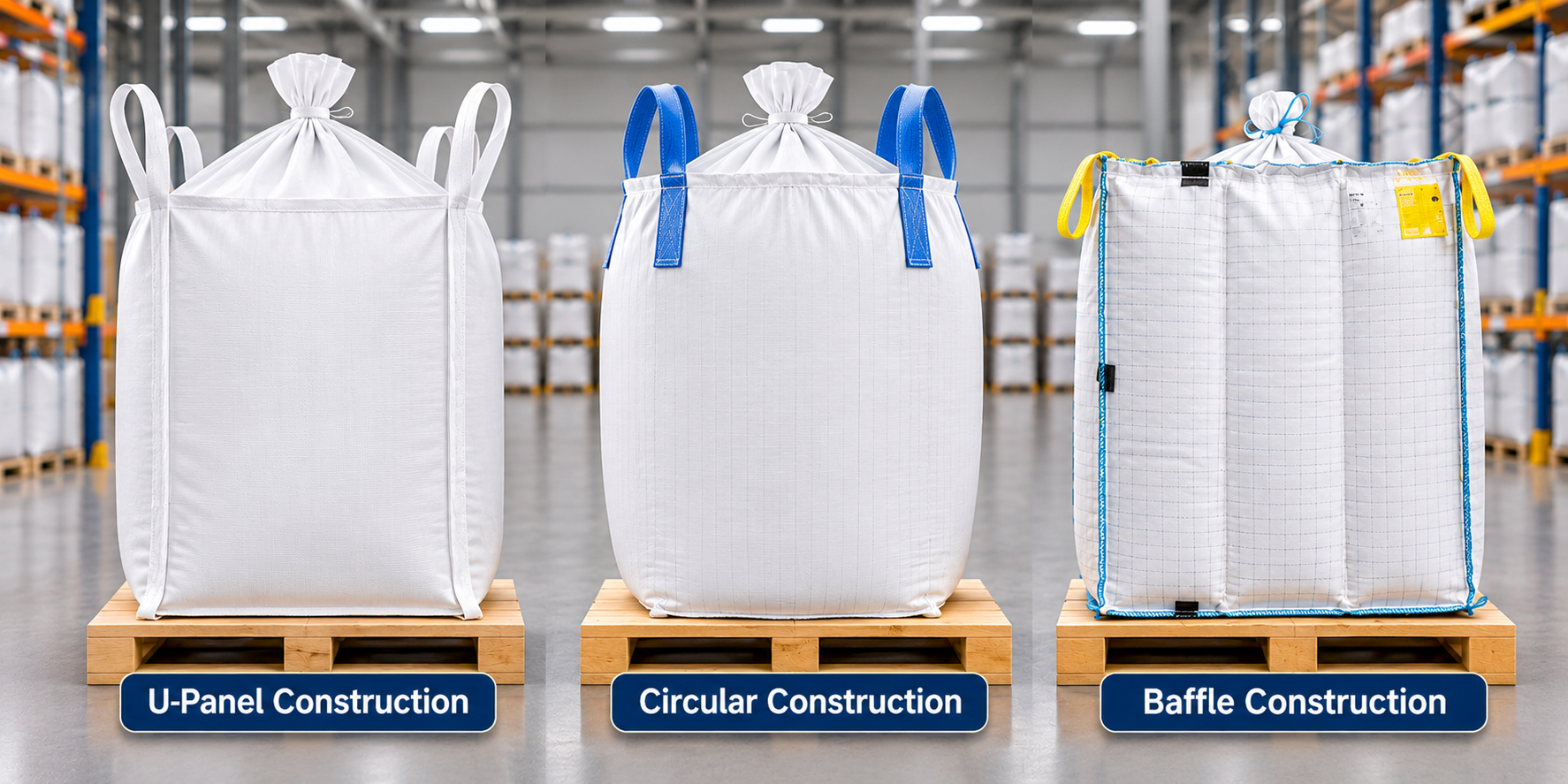
Body construction is one part of the finished design. Bring fill weight, product behaviour, equipment, and footprint into the same discussion.
A continuous panel forms the bottom and two opposite sides, with separate panels completing the body. Review dimensions, seams, and lifting requirements together.
Fabric woven as a tube forms the body without vertical side seams. Explore nominal 35 × 35, 36 × 36, and 39 × 39 inch footprints in our capacity calculator. Top, bottom, and lifting components complete the finished construction.
Four individual side panels form the body. Specify the finished dimensions and construction details against your filling and handling process.
Internal corner panels help the filled bag retain a more square profile. Review product flow, liner compatibility, and the intended pallet or shipping footprint.
Define opening sizes, closure details, and equipment interfaces around the product and your operating procedures.
A full-width opening provides access for filling. Define how the product will be contained and protected after filling.
An extended fabric top opens for filling and gathers for closure. Include your closure method and product protection requirements.
Match spout diameter, length, ties, and any liner extension to your filling head and operating procedure.
A closed base suits applications without a discharge spout. Discuss the intended unloading method before selecting the construction.
Specify diameter, length, closure, and equipment interface around the product’s flow and required discharge rate. Include a bottom protection flap if needed.
A larger bottom opening may be considered where the process calls for it. Review support equipment and the complete discharge arrangement.
Discuss access to the closure and a release arrangement suited to your discharge station and operating procedure.
Share the required discharge rate, product flow characteristics, and receiving equipment so flow-control features can be reviewed.
Specify the components that connect the bag to your handling process and product protection requirements.
Discuss coated or uncoated woven polypropylene, breathable or ventilated construction, fabric weight, colour, and exposure conditions. Match the fabric to the complete design and intended load.
Specify sift-resistant seams and dust-containment needs using your product’s particle size and handling conditions. Review the proposed construction and liner together.
Explore tubular, form-fit, and form-fit baffle liners. Share polyethylene, foil barrier, moisture, oxygen, and other material requirements for review.
Discuss inserted, sewn-in, glued-in, or tabbed attachment. Include any requirements for replacement liners or liners supplied on rolls.
Include stencilling, print artwork, labels, lot identification, and document pouches. Identify sides, print colours, and required information.
Include food contact, Type C, CROHMIQ Type D, or UN HazMat needs at the outset. Construction options must be reviewed with the relevant material documentation and design qualification.
Share the actual equipment and intended lifting method so the arrangement can be specified with the complete construction.
Specify loop arrangement, free height, width, and equipment clearance. Review all lifting points as part of the approved bag design.
Discuss a strap arrangement for centre pick-up where required by your lifting equipment. Confirm the lifting method against the design and its instructions.
Share fork dimensions, spacing, and insertion requirements to review sleeves with your handling equipment.
Discuss loops that help present the lifting points and colour identification for your operation. Define the arrangement in the bag drawing.
Empty dimensions are a starting point. Review the filled bag with your product, equipment, and shipping layout.
Start with pallet dimensions and usable truck, container, or rail space. Confirm filled bag dimensions, clearances, and loading requirements for your route.
Provide target net weight and bulk density. Review volume, settled shape, fabric, seams, loops, and the specified safe working load together.
Include filling head height, lifting clearance, discharge station dimensions, and storage restrictions when choosing the bag height.
Review how internal baffles and any liner affect filling, product movement, discharge, and the bag’s filled profile.
Sizing guidelines: All sizes and capacities shown—including published U-panel and baffle designs and circular estimates—are guidelines only. Bulk-Pack can help you determine the right bag size and design for your product, equipment, and handling requirements.
Fabric stretch & sizing estimates: Fabric stretch varies by manufacturer, fabric construction, elongation, load, product characteristics, filling conditions, and other factors. Actual filled dimensions, shape, and usable capacity may differ from chart values and calculated estimates. Confirm the final design, dimensions, capacity, and safe working load with Bulk-Pack and the manufacturer.
Our 45+ years of FIBC manufacturing and sales experience help turn operating requirements into a clear bag specification.
Start with your product’s bulk density, particle size, flow characteristics, fill temperature, and target weight. Add filling equipment, lifting method, storage, discharge, delivery timing, and any food contact, electrostatic, or hazardous materials requirements.
Use these industry references to prepare for a design discussion.
Work through the questions behind a complete bulk bag specification.
FIBCA Design Guide ↗Review the terms used for bag components and construction features.
FIBCA Terminology ↗Explore food contact, electrostatic, and UN HazMat product pages.
Explore FIBC Product Types ↗Start with target fill weight and product bulk density, then review filling behaviour, settled dimensions, handling clearances, and pallet or transport limits. Confirm the proposed dimensions through the specification and application review.
Baffle describes the internal construction. Electrostatic classification is a separate requirement that must be specified with the complete bag and liner design.
Coating and liners serve different construction and containment needs. Share the particle size, moisture sensitivity, barrier requirements, and contact conditions so the appropriate combination can be reviewed.
Share your equipment dimensions and proposed change. Review spouts, closures, liners, and any qualification requirements before changing an approved specification.
Include these requirements at the start of the review. They require product-specific documentation and, where applicable, qualification beyond the bag’s shape and openings.
Yes. Send your drawing or current specification, photos, product information, target fill weight, and details of filling, lifting, storage, and discharge.
Share your product, bulk density, target fill weight, dimensions, filling and discharge equipment, liner requirements, and quantity. Include your drawing or current specification.