
Limit moisture exposure.
Review the film specification, thickness, seals, and closures against your product’s moisture sensitivity and expected transit conditions.
Moisture protection.
Product integrity.
Protect powders and sensitive dry bulk products with a polyethylene film liner configured for your shipment. A PE film barrier helps limit moisture exposure and separates your product from the container interior, with loading and discharge details matched to your operation.
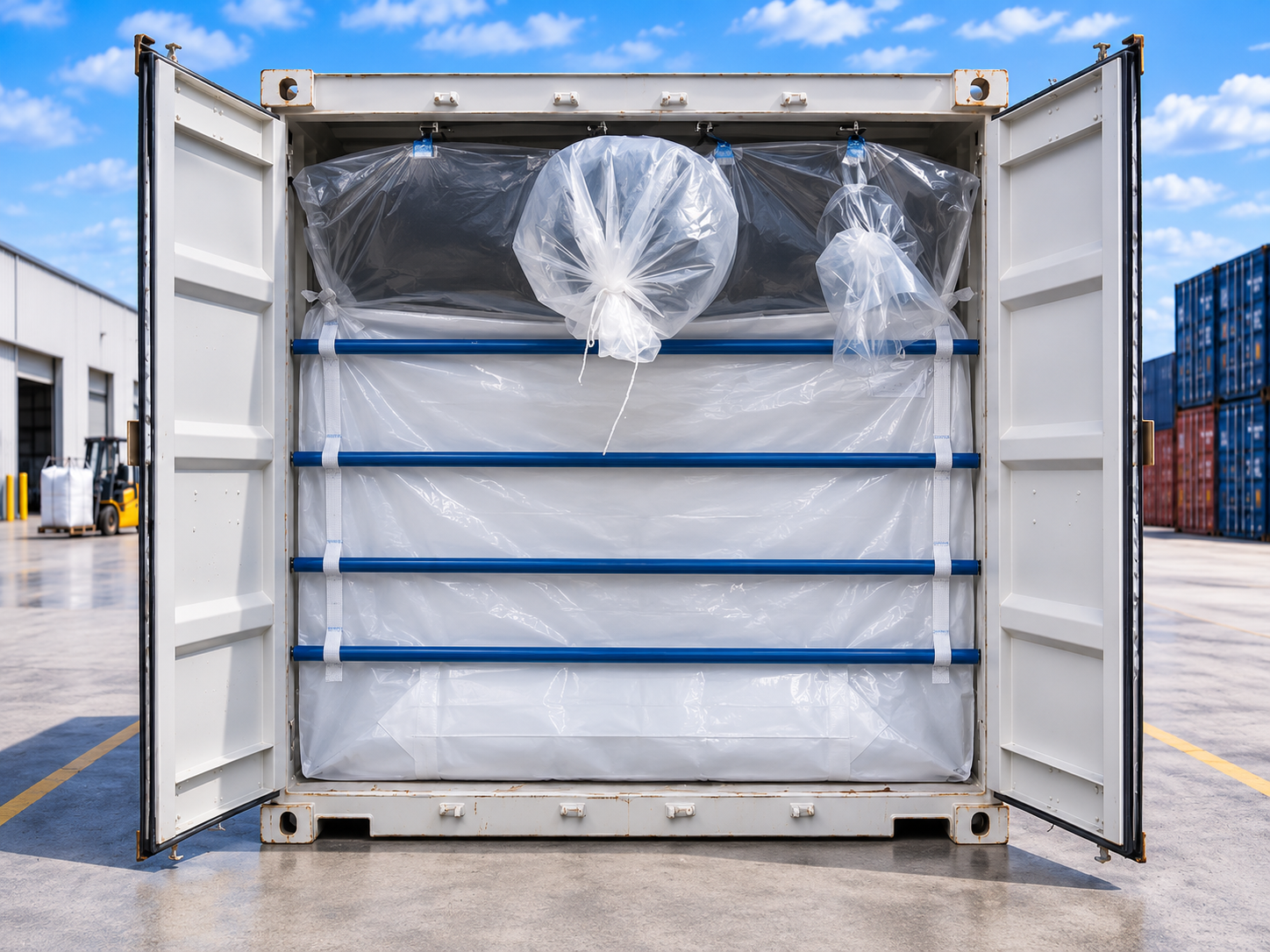
PE film bulk container liners are a strong starting point for moisture protection and contamination barriers when shipping powders and sensitive dry products. Match the film, seals, and closures to your specific protection requirements.
Review the film specification, thickness, seals, and closures against your product’s moisture sensitivity and expected transit conditions.
Create a product-contact layer between the cargo and the container interior. Include installation cleanliness and closure practices in the review.
Discuss fine-powder containment, flow behavior, filling connections, and discharge needs alongside any product-contact documentation.
Use your existing drawing as a starting point, or work through the requirements with the Bulk-Pack team.
Define the polyethylene film specification, thickness, and handling requirements. Review the proposed film for the product, shipment, and installation process.
Share the product’s moisture sensitivity, transit duration, and storage conditions. Include any target water vapor transmission rate and its test conditions for review.
Review seams, sleeves, closures, and connection points together. Fine powders need attention to potential leakage paths throughout filling, transport, and discharge.
Provide actual container inside dimensions, attachment points, intended load, and the required bulkhead or support arrangement.
Send equipment and connection dimensions, filling method, venting needs, and the destination unloading process.
Identify product-contact requirements, cleanliness expectations, compatibility needs, quantities, and delivery timing. Send supporting specifications with the inquiry.
Inspect the container interior and review cleanliness, sharp edges, liner fit, attachment, and the specified support arrangement before installation.
Review filling connections, venting, seals, closures, and handling conditions to help maintain the product barrier throughout loading and transport.
Confirm receiving connections and the unloading procedure with the destination facility before the shipment begins.
They are a strong option to review for powders and sensitive dry bulk products where moisture protection and separation from the container interior are priorities. Confirm the film, openings, seals, and handling process for your application.
Protection depends on the specified film, thickness, seals, closures, handling, and exposure conditions. Share your moisture-barrier targets and any required test data so the proposed construction can be reviewed.
The liner creates an internal product-contact barrier between the cargo and container surfaces. Clean installation, suitable filling connections, secure closures, and careful handling also matter.
Share particle size, flow characteristics, bulk density, and filling and discharge methods. Review seals, venting, connections, and containment requirements with the complete liner design.
Identify the product, intended contact conditions, and required documentation. Confirm the proposed film and complete liner construction meet your application’s requirements before ordering.
Send the product, intended load, container inside dimensions, film thickness if known, moisture-protection needs, filling and receiving equipment, quantity, and delivery requirements.
Tell us about your powder or sensitive product, moisture-protection needs, container size, loading method, and destination unloading process. Share your film specification or liner drawing to start the conversation.