
Below 6 kV
LABORDATA’s summary of IEC 61340-4-4:2018 specifies Type B fabric breakdown voltage below 6,000 volts. Request the applicable test documentation for your construction.
Know the material.
Choose the right protection.
Type B bulk bags use low-breakdown-voltage materials to prevent propagating brush discharges. They do not dissipate static charge. Let’s review your product and operation before selecting a bag.
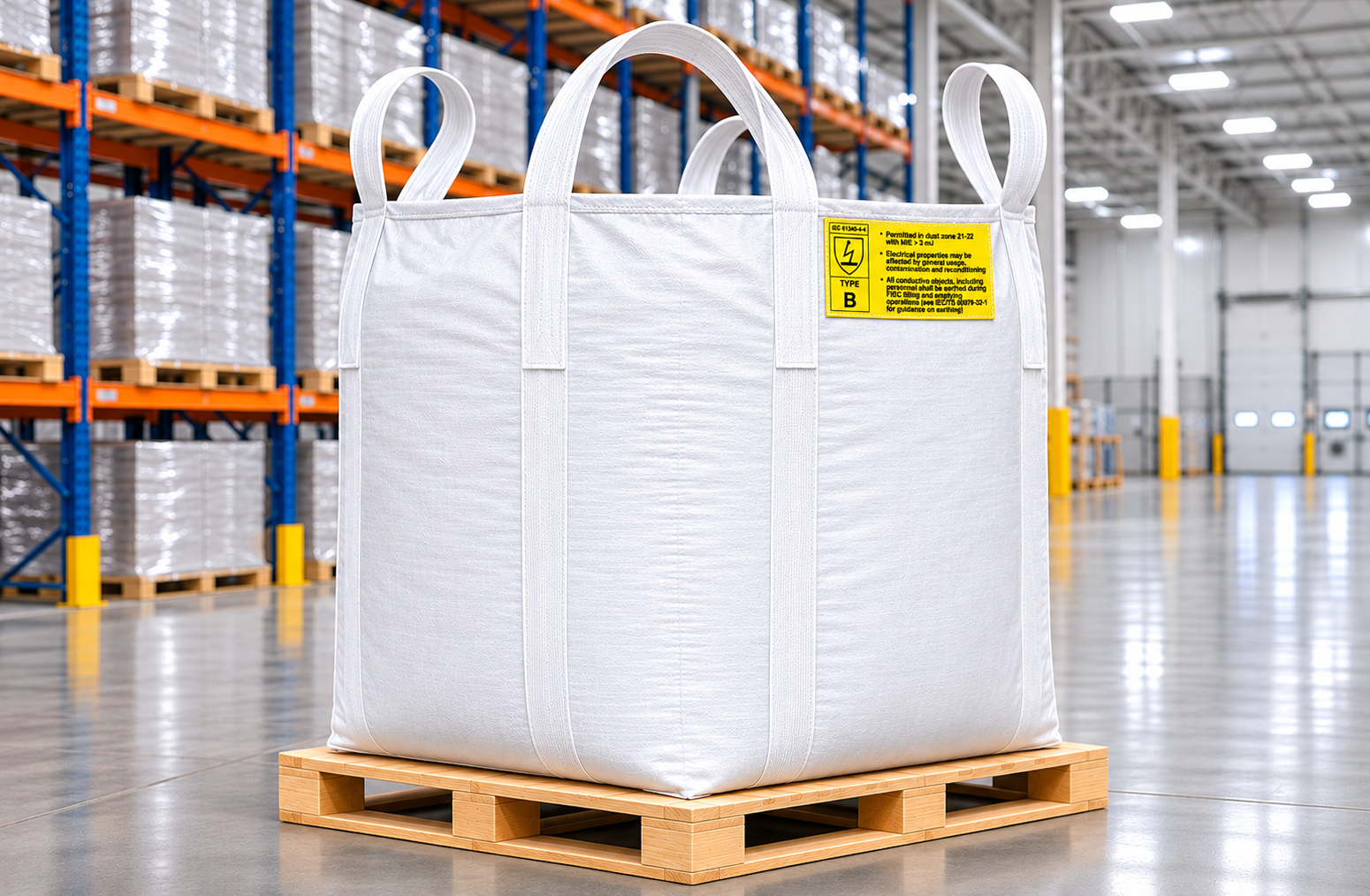
Type B is made from non-conductive materials. Its electrical breakdown characteristics distinguish it from a conventional Type A bag.
LABORDATA’s summary of IEC 61340-4-4:2018 specifies Type B fabric breakdown voltage below 6,000 volts. Request the applicable test documentation for your construction.
Low breakdown voltage prevents propagating brush discharges. It does not make the bag conductive or provide the static-dissipation mechanism of Type C or Type D.
Selection depends on the product and operating conditions. Type B is not suitable for flammable gas or vapor atmospheres.
References: LABORDATA Type B requirements ↗ · IFIBCA electrostatic classification overview ↗
Bring the handling requirements and electrostatic requirements into one specification discussion.
Share your product characteristics, dust ignition data, filling and emptying conditions, and site assessment. Identify any flammable gases or vapors.
Define dimensions, safe working load, bag style, lifting loops, filling opening, discharge, printing, and storage needs.
Include the liner specification, coatings, labels, and document pockets. Review the complete package rather than fabric alone.
Request design-specific test documentation and operating instructions. Tell us quantities, delivery location, and timing.
Our 45+ years of FIBC manufacturing and sales experience help us ask the right questions about your product, bag design, and handling process.
Talk with us about custom runs, specification reviews, and supply planning. We can help clarify the requirements before you commit to a construction.
The classification is one part of a complete bag specification. Use the technical references and discuss your application with our team.
Review the fabric, liner, label, and document-pocket requirements.
LABORDATA requirements ↗Explore the standard covering electrostatic classification and test methods for FIBCs.
IEC 61340-4-4 overview ↗Explore Type C, CROHMIQ Type D, and other bag configurations.
Explore FIBC product types ↗No. Type B limits propagating brush discharges through low-breakdown-voltage materials; it does not provide a mechanism to dissipate accumulated static charge.
Type B has no designed conductive path to earth. Adding a clamp does not turn it into a Type C bag. Grounding requirements for equipment, personnel, and other conductive objects remain part of the site’s operating procedures.
No. Type B is not suitable where flammable gas or vapor atmospheres are present. Share the complete process environment so the appropriate bag classification can be reviewed.
A compatible liner may be specified, but its electrostatic properties and the complete bag construction require review. Do not substitute a liner without checking the design requirements.
No. Electrostatic classification, food-contact suitability, and UN dangerous-goods qualification address different requirements. Specify each requirement separately and request supporting documentation.
Yes. Send the specification, product and process information, bag dimensions, fill weight, liner details, and required documentation. We can help identify points needing clarification.
Share your product, dust ignition information, operating environment, dimensions, liner requirements, and quantity. Your existing specification is a useful starting point.