
Conductive construction
Interconnected conductive threads or tapes create a pathway through the bag to designated grounding points.
Conductive.
Grounded containers.
Type C FIBC bulk bags incorporate interconnected conductive materials to provide a path for static charge dissipation to earth. The bag must remain properly grounded during filling and emptying.
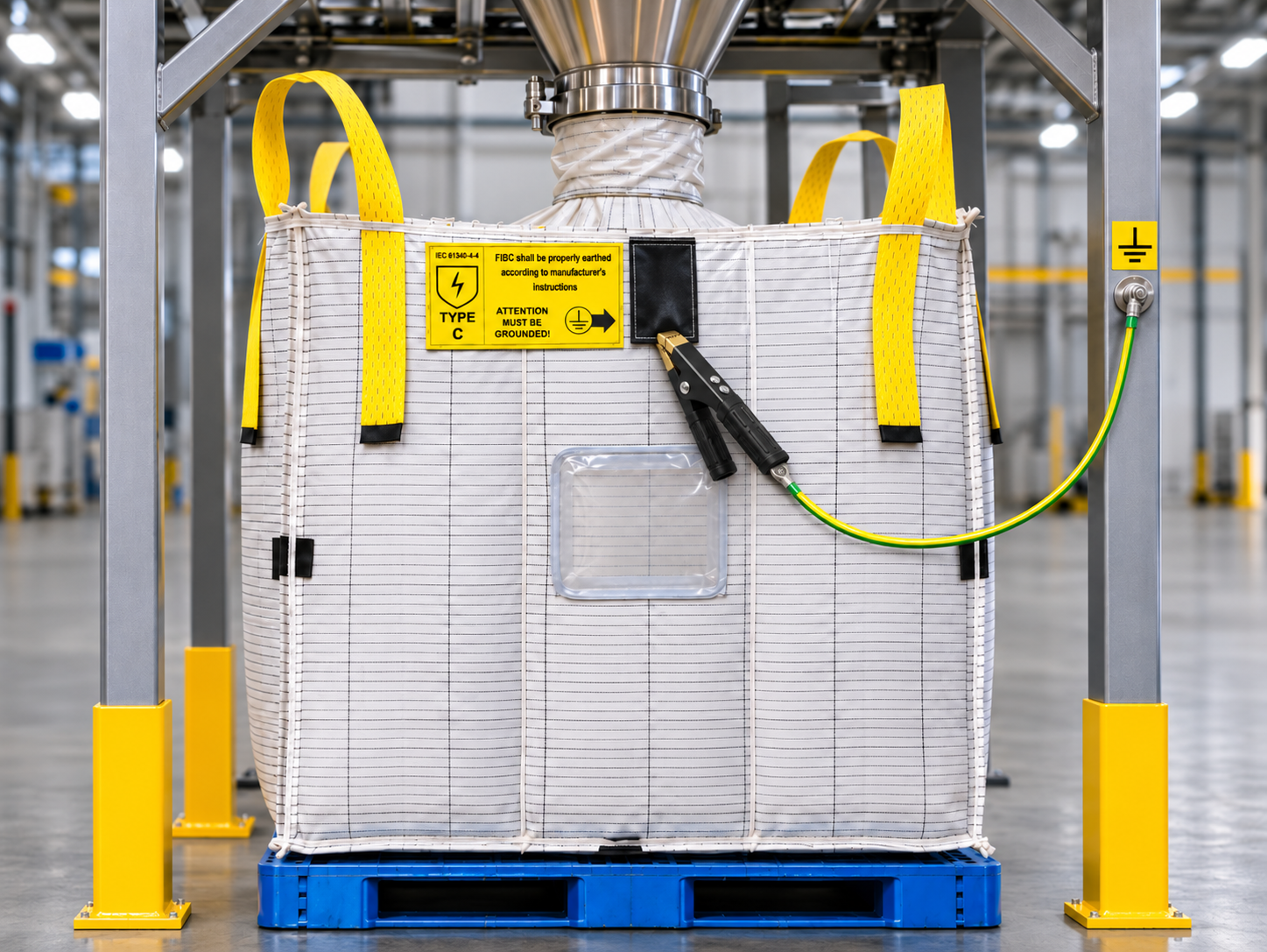
Conductive yarns or tapes are integrated into the fabric structure. Their arrangement and electrical connections must work together in the finished bag.
Interconnected conductive threads or tapes create a pathway through the bag to designated grounding points.
Use the marked connection points specified for the bag. Do not assume every lifting loop is a grounding point.
Review fabric, seams, openings, liner, labels, document pockets, and attachments as part of the finished design.
Request design-specific electrostatic test documentation, operating instructions, and the applicable classification label.
The IEC 61340-4-4:2018 edition increased the Type C resistance limit to 100 MΩ (108 Ω). The relevant bag measurement is resistance to the designated groundable point—not a blanket “surface resistivity between any two points” specification.
Define the applicable test method and acceptance criteria in your specification. The complete bag and any liner need the appropriate qualification.
Type C requirements may arise in chemical, petrochemical, pharmaceutical, pigment, and other powder-handling operations with electrostatic ignition hazards.
Industry alone does not establish suitability. Share the product characteristics, dust or vapor hazards, filling and discharge conditions, and your site’s assessment. Metal powders, catalysts, and energetic materials require specific technical evaluation; they are not automatically approved by a Type C classification.
Grounding is essential to Type C operation. Build the bag connection into the site’s documented process and follow the bag and grounding-equipment instructions.
Connect the specified grounding point to the site’s verified earth system before product movement. Maintain the connection throughout filling and emptying.
Have your site define inspection, connection verification, monitoring, and testing procedures suitable for its equipment and hazards.
Train operators to recognize the label and grounding points, identify damaged connections, and follow the site’s response to a lost ground.
The conductive network provides a route for charge to reach earth. An ungrounded conductive bag can accumulate charge and produce hazardous spark discharges. Maintain the specified connection throughout filling and emptying.
No. The bag’s resistance-to-groundable-point qualification and the site’s grounding-system requirements are different considerations. Do not use the bag classification limit as a universal acceptance value for a clamp, earth connection, or monitoring system.
Send its specification for review. Liners and other components must be compatible with the Type C design and its intended use. A liner change can affect the electrostatic performance of the complete package.
Only use a loop as a grounding connection when it is specifically designated for that purpose in the bag’s design and instructions.
Yes. Send your existing specification, product and process information, bag dimensions, safe working load, liner details, and required documentation. We can help identify points needing clarification.
Share your product, operating environment, bag design, liner requirements, grounding arrangement, and quantity. Send your current specification to start the discussion.