
49 CFR 172
Locate the proper shipping name, UN/NA number, hazard class, and packing group in the Hazardous Materials Table. Review Column 7 special provisions and Column 8 packaging references.
Hazardous Materials Table ↗Special provisions ↗
The right design.
The right documentation.
Start with the material’s classification. Match the authorized packaging, tested bag design, markings, and closure instructions to the shipment.
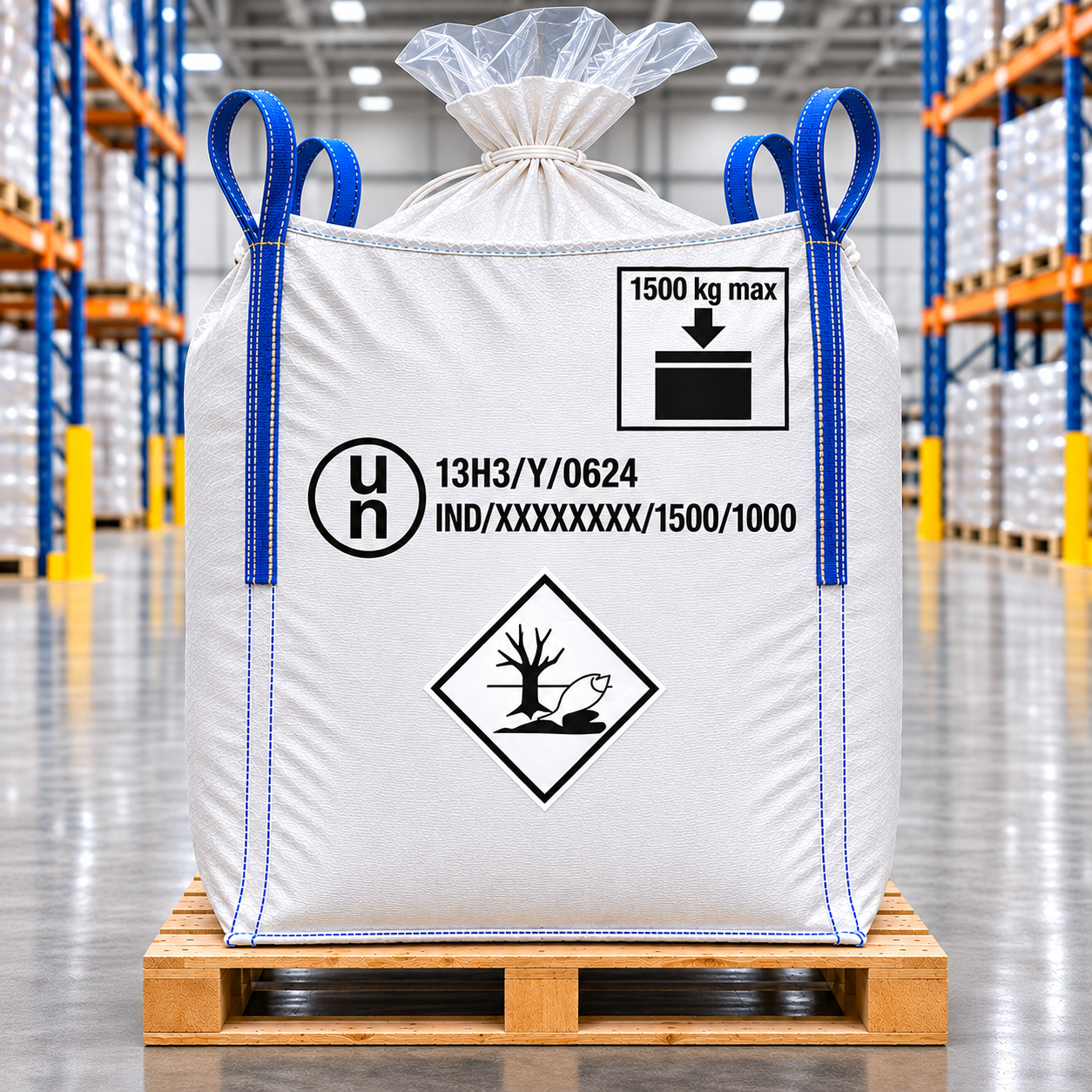
Part 178 covers packaging construction and testing. It works alongside the material-specific requirements in Parts 172 and 173.
Locate the proper shipping name, UN/NA number, hazard class, and packing group in the Hazardous Materials Table. Review Column 7 special provisions and Column 8 packaging references.
Hazardous Materials Table ↗Follow the packaging section assigned to the entry. For example, § 173.240 permits certain flexible IBCs subject to its conditions and the material’s IBC provisions.
Bulk packaging requirements ↗Part 178 Subparts N and O address IBC construction and testing. UN Model Regulations Chapter 6.5 provides the international IBC framework; applicable national and transport-mode rules govern the shipment.
Flexible IBC construction ↗Search 3,003 numbered entries from the U.S. Hazardous Materials Table by name or UN/NA number. Multiple packing-group entries may appear.
This is a reference lookup, not a list of products approved for every FIBC. Check the full entry, all special provisions, packaging rules, and your bag’s qualified design before shipment.
Your summary includes matching entries, packing groups, special provisions, packaging reference links, and the review disclaimer.
Review before transport. These lookup results are for reference only and do not establish packaging suitability or shipment approval. Before transport, review your results with a qualified hazardous-materials professional or Bulk-Pack’s UN-trained team to confirm the correct packaging, proper markings and labels, closures, and use for your material, transport mode, and destination. Verify current regulations and your packaging’s qualified design. The shipper remains responsible for proper classification, packaging, and hazard communication.
eCFR snapshot: October 29, 2026. This saved table does not update automatically. Verify against the current table ↗ · Read current special provisions ↗
The UN packaging mark is separate from the shipment’s UN identification number, hazard labels, and other required transport markings.
[UN symbol] / 13H3 / Y / MM YY / COUNTRY / MAKER / STACK kg / GROSS kg13H1: woven plastic without coating or liner.
13H2: coated woven plastic.
13H3: woven plastic with liner.
13H4: coated woven plastic with liner.
X: Packing Groups I, II, III tests.
Y: Packing Groups II, III tests.
Z: Packing Group III tests.
The material still needs the applicable packaging authorization.
Month and year of manufacture, the country authorizing the mark, and the manufacturer or certifying agency’s name or registered symbol identify the packaging.
The mark includes stacking test load and maximum permissible gross mass. A separate stacking symbol communicates permitted stacking load or that stacking is not allowed.
§ 178.703 — marking requirements ↗ · § 178.710 — flexible IBC codes ↗. Actual marks must match the qualified design and required format.
Qualification applies to a defined design. The flexible-IBC test program includes the following tests, subject to the applicability rules in § 178.803.
Impact performance at the applicable packing-group height.
§ 178.810 ↗Lifting performance for designs handled from the top or side.
§ 178.812 ↗Performance under the prescribed superimposed load.
§ 178.815 ↗Performance when the filled bag is toppled onto its top.
§ 178.816 ↗Recovery of a bag from its side using the specified lifting devices.
§ 178.817 ↗Resistance to propagation of a prescribed cut.
§ 178.818 ↗Vibration: flexible IBCs must also be capable of withstanding the vibration test.
Requalification & records: § 178.801 generally requires design requalification at least every 12 months unless an approved alternative applies. Request the design report, test results, limits, and closure instructions.
Complete design: review changes in dimensions, materials, liner, or construction against the applicable qualification and variation provisions.
§ 178.801 — qualification and reports ↗ · § 178.803 — test applicability ↗. Testing conditions and pass criteria are defined in the linked sections.
Our 45+ years of FIBC manufacturing and sales experience bring practical design knowledge to your packaging review. Share your SDS, classification, operating requirements, and current bag documents.
We’ll help identify the construction, liner, closure, testing, markings, and supply questions that need to be resolved for your application.
No. The mark identifies a tested packaging design and its performance level. The material’s table entry, special provisions, packaging authorization, compatibility, and design limits must also be satisfied.
The search helps locate the table entry and its references. An IB8 listing identifies a provision that includes flexible IBC types; it does not resolve all other restrictions or establish suitability for your formulation and shipment.
No. Transport performance qualification and electrostatic classification address different requirements. Tell us if both are needed so the complete design can be reviewed.
Send the proposed change for review against the qualified design, applicable variation provisions, and test documentation. Follow the manufacturer’s closure instructions.
The person offering hazardous material for transportation has responsibilities under 49 CFR 173.22, including correct classification and selection of an authorized packaging. Bulk-Pack can help review bag requirements and supporting documentation.
Send the UN/NA number, proper shipping name, hazard class, packing group, SDS, fill weight and density, bag dimensions, liner and closure details, transport modes, destination, and quantity.
Share the UN/NA number, proper shipping name, hazard class, packing group, SDS, fill weight, and transport route. Include your existing bag specification and required documentation.