
Set the target
Tell us which solids must remain in the bag and what you need from the drainage process.
Let liquid drain.
Keep your process moving.
Review a dewatering bulk bag around the material you handle and the solids you need to retain. Bulk-Pack can help connect your drainage, handling, and bag design requirements.
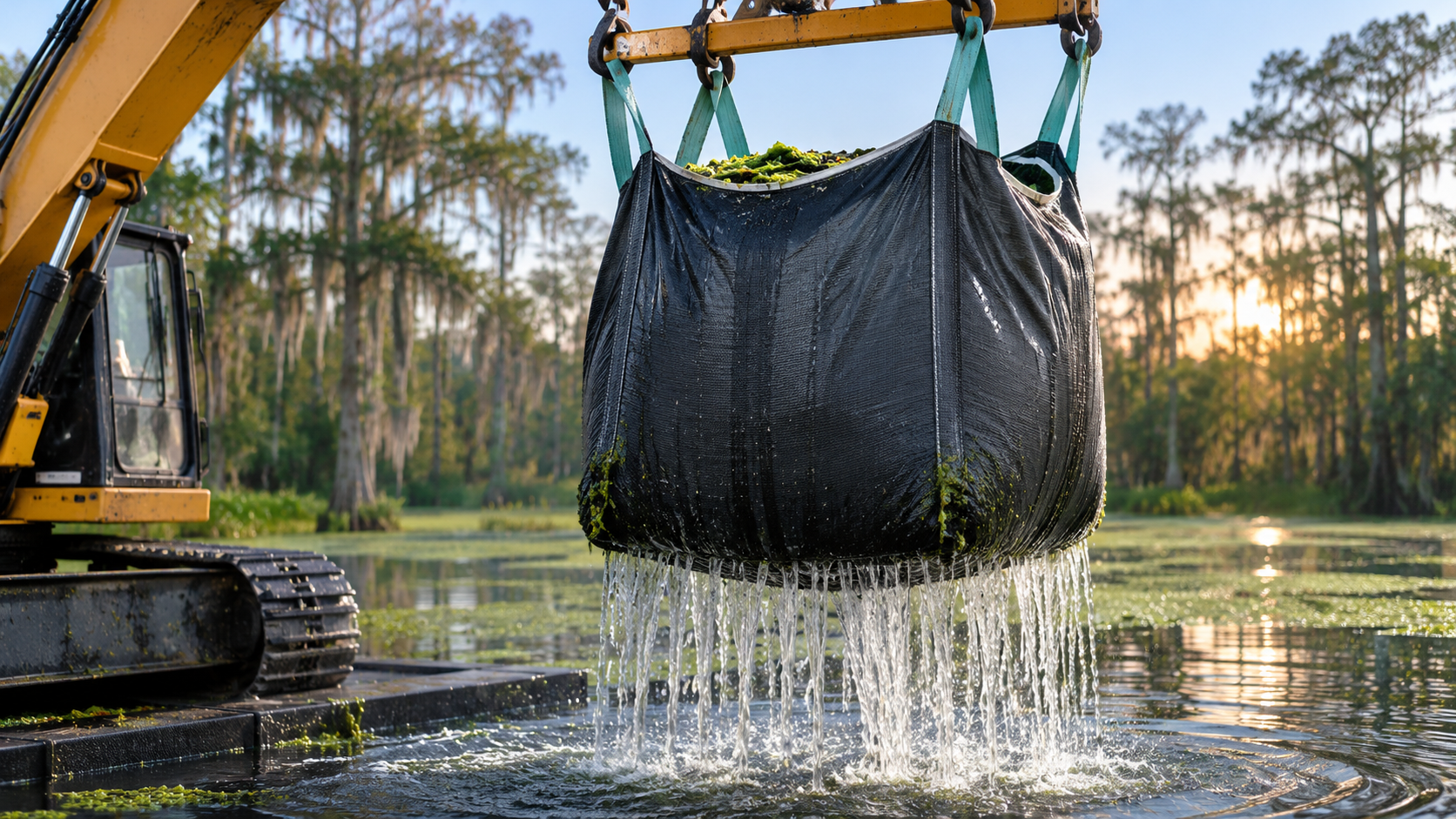
Dewatering FIBC fabric separates liquid from solids through an uncoated fabric construction.
Tell us which solids must remain in the bag and what you need from the drainage process.
Bring the filling method, support equipment, liquid collection, and lifting requirements into one discussion.
Request the proposed bag specification and confirm application performance before committing to a process.
Discuss requirements for applications including wastewater, industrial sludge, mining and aggregates, construction, and remediation.
Use these guideline specifications as a starting point, then review your material and operation with Bulk-Pack. Confirm the current design, load rating, availability, and operating instructions for the bag you order.
Dimensions and capacities are guidelines only. Bulk-Pack can help size the right bag for your material and process.
Your process information helps frame the fabric, construction, and handling questions that need to be resolved.
Describe the solids and liquid, their compatibility requirements, temperature, and any relevant material documentation.
Share the particle-size distribution and the solids you need to retain. Ask for fabric performance information relevant to your material.
Define the liquid volume, desired drainage time, filling method, and how performance will be evaluated in your process.
Show us the bag support arrangement, drainage area, and how the released liquid will be collected and handled.
Specify the maximum contents weight during filling and handling, lifting equipment, clearances, and unloading method.
Include expected usage, delivery location, drawings, required records, and the documentation your operation needs.
Our 45+ years of FIBC manufacturing and sales experience help translate your operating needs into a clear specification discussion.
Share your current bag, drawing, process photos, and performance goals. We can help review the construction and product documentation with your team.
Use product and industry information alongside the instructions for your particular bag design.
Ask Bulk-Pack for the specification and documentation relevant to your application.
Request Product Information ↗Review the association’s general handling guidance with your bag-specific instructions.
FIBCA Handling Guidelines ↗Explore body styles, openings, lifting loops, and specification considerations.
FIBC Constructions and Design ↗A dewatering design uses uncoated fabric to let liquid drain while retaining solids. Tell us whether your process needs drainage, liquid containment, or another function so the construction can be reviewed.
Request the filtration and retention data for the proposed fabric. Confirm the retention characteristics for the specific fabric and construction. Share your particle-size distribution and define how retention will be checked with your material.
Drainage performance must be evaluated for the particular material and bag design. Share your material, solids concentration, operating conditions, and required cycle time so the team can review the application and any evaluation needed.
Reuse must be reviewed for the specific bag design and application. Confirm the instructions, inspection criteria, material compatibility, and suitability for another use with Bulk-Pack before planning reuse.
Do not infer transport qualification from the dewatering function or listed capacity. Share your material classification, proposed shipment, and required packaging documentation for a separate review.
Send your current drawing or describe the process. We can review the required dimensions, filling and discharge details, fabric, handling arrangement, and design options with you.
Share your material, liquid content, particle size, target fill weight, drainage requirements, handling equipment, and quantity. Include any existing specification or process details.